


Navigating Stairs Safely
Navigating Stairs Safely: Your Ultimate Guide to Avoiding Falls at Home
For many older adults, stairs can go from being a normal part of the home to a source of anxiety. Whether it’s a few steps leading out of the house or a full staircase to the second floor, navigating steps safely is one of the most critical components of maintaining your independence.
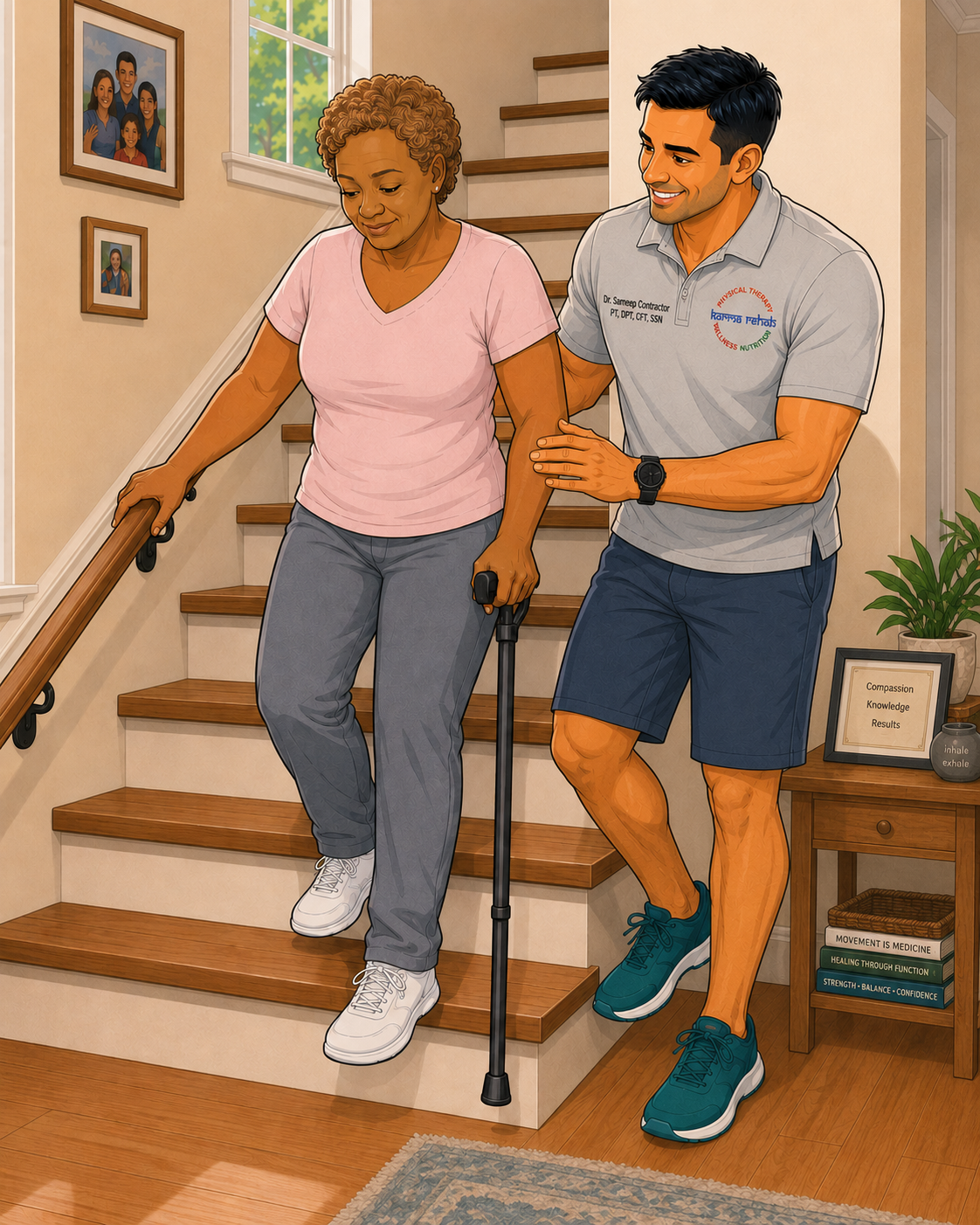
At Karma Rehab, we believe that staying safe doesn't mean avoiding your stairs—it means mastering them.
Here is a clinical guide on how to safely navigate stairs, modify your environment, and protect your joints.
1. The Golden Rule of Stair Safety: "Up with the Good, Down with the Bad"
If you experience weakness or joint pain on one side of your body, memorizing this simple physical therapy phrase can save you from a fall:
Going UP (Lead with your stronger leg): Step up first with your stronger or non-painful leg. Push down through that heel to lift your body weight up, then bring your weaker leg up to meet it on the same step.
Going DOWN (Lead with your weaker leg): Lower your weaker or more painful leg down to the next step first. This ensures that your stronger leg is doing the hard work of controlling and lowering your body weight. Bring the stronger leg down to meet it.
2. How to Correctly Use Handrails and a Cane
Many people use their walking aids incorrectly on stairs, which can actually throw off their balance.
The Handrail is Your Anchor: Always keep at least one hand firmly gripped on the handrail. If you have rails on both sides, use them both. Never "ghost" your hands over the rail—hold it.
Using a Cane on Stairs: Hold your cane in the hand opposite your weaker leg, or whichever hand is free if you are using a handrail.Going Up: 1. Strong leg steps up. 2. Cane and weaker leg step up together to meet it.Going Down: 1. Place the cane down on the step below first. 2. Step down with the weaker leg. 3. Bring the strong leg down last.Tip: If you encounter stairs where the steps are too narrow for your feet, do not let your heels or toes hang off the edge. Instead, turn your feet slightly sideways so that as much of your foot as possible makes solid contact with the step. If the stairs feel too narrow to navigate safely even with this adjustment, the best choice is to avoid using those stairs altogether.
3. Modifying the Environment for Maximum Safety
Physical technique is only half the battle; your environment needs to support you. Making a few quick, inexpensive updates to your home staircase can drastically lower fall risks:
Lighting is Everything: Shadows can trick the eyes and mask where a step ends. Ensure there are light switches at both the top and bottom of the stairs. Consider installing inexpensive, motion-activated LED strip lights underneath the lip of each step or along the baseboards.
Define the Edge with Color Lines: As we age, contrast sensitivity decreases, making it hard to tell where one step changes and becomes another. Apply a highly visible, contrasting color line (such as a strip of bright yellow or white non-slip tape) right at the very edge (the nosing) of each step. This gives your brain an immediate visual cue of exactly where to place your foot.
Enhance Surface Texture: Slippery surfaces cause falls. If you have bare wood or tile stairs, add non-slip adhesive treading or low-profile carpet runners. If your stairs are already carpeted, ensure the carpet is tightly tacked down and not loose or bunched. Never wear loose slippers or smooth socks on the stairs—always wear shoes with good rubber traction or go barefoot if necessary.
Balance and Strength Go Hand-in-Hand
Environmental tweaks are excellent, but the ultimate defense against stair anxiety is building the leg strength and balance required to climb them effortlessly. In our physical therapy sessions, we work directly on the specific muscle groups (like the quads and glutes) that power you safely up and down steps.
If you or a loved one is feeling unsteady on the stairs, don't wait for a slip to happen. Let’s work together to rebuild your confidence and your strength.
Your Karma Rehab team helps adults 55+: ✔ Improve strength and balance for everyday tasks ✔ Walk safer and more confidently ✔ Recover after illness, surgery, cancer or falls ✔ Reduce fall risk ✔ Stay active and independent and SAFE!
Take the Right Step
If you or a loved one have noticed any of these warning signs, now is the best time to take action before a fall happens.
Reply to this email or visit our website to learn how we can help you move safer, get stronger, and stay independent. Our mobile concierge service is specifically designed for seniors who want to maximize their strength and confidence. Reply to this email or visit our website to learn how we can help you thrive.
Be Better Tomorrow Than You Were Yesterday Dr. Sameep Contractor PT, DPT, CFT, SSN Owner, Karma Rehab Inc.


Comments